
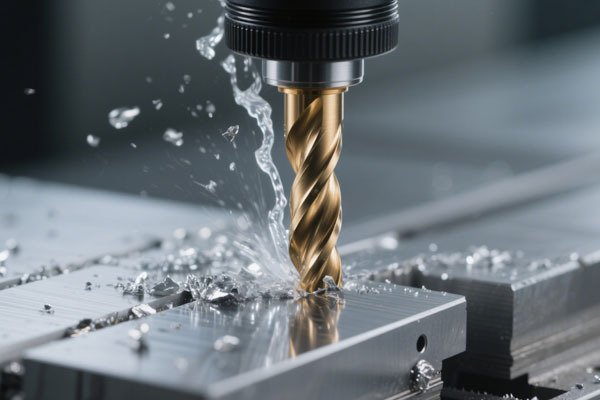
In the kingdom of metalworking, milling cutters act like intrepid explorers. Faced with ever-changing material properties, every cut is a profound dialogue with the material’s intrinsic nature. The workpiece material is the invisible conductor in this precision dance. Today, let’s unveil the secret of how different metals profoundly shape milling processes.
I. Material Properties: The Genetic Code of Machinability
- Strength & Hardness: Determine cutting force magnitude and tool wear rate. Higher strength/hardness means greater cutting resistance and faster tool wear (e.g., hardened steel, superalloys).
- Toughness: Influences chip formation and breakability. High toughness materials (e.g., titanium alloys, stainless steel) tend to produce continuous, long chips with high wrapping risk.
- Thermal Conductivity: A critical factor in heat management. Poor conductivity (e.g., titanium alloys, stainless steel) causes heat to concentrate in the cutting zone, accelerating thermal tool wear.
- Work Hardening Tendency: Some materials (e.g., stainless steel, nickel-based alloys) experience rapid surface hardening during cutting, increasing subsequent cutting difficulty and tool wear.
- Chemical Affinity: The tendency for the material to react chemically with the tool coating/substrate (e.g., aluminum adhesion, diffusion wear with carbide in titanium).
II. Material Challenges & Milling Strategies: Practical Analysis
1. Aluminum Alloy: King of Speed, Plagued by Adhesion
Properties: Soft, low strength, good thermal conductivity, but low melting point, prone to adhesion.
Challenges:
- Built-Up Edge (BUE): Soft aluminum easily adheres to the cutting edge, degrading edge geometry and surface finish.
- Burr Control: Prone to burrs at machined edges.
- Dimensional Stability: Low elastic modulus, thin-walled parts susceptible to distortion.
Milling Cutter Strategy:
- Sharp Cutting Edge + Large Rake Angle: Reduce cutting forces, suppress BUE.
- High-Polish Flank/Special Coatings (e.g., Diamond-Like Carbon – DLC): Reduce friction, prevent aluminum adhesion.
- High Helix Angle (45°+) & Large Chip Gullet: Facilitate chip evacuation, prevent scratching finished surfaces.
- High-Speed Cutting (HSC): Utilize high RPM and feed rates to eject chips rapidly.
Key Parameters: Very High Vc (often >1000 m/min), Large fz.
2. Stainless Steel: The Tough Warrior, Hardening Trap
Properties: Medium-high strength, good toughness, poor thermal conductivity, significant work hardening (especially austenitic grades like 304/316).
Challenges:
- High Cutting Forces & Vibration: Toughness absorbs energy, prone to vibration.
- Intense Heat & Thermal Wear: Poor conductivity concentrates heat at the cutting edge.
- Work-Hardened Layer: Cutting hardens the surface layer, making subsequent cuts like “chewing through a hard shell.”
- Adhesion & Long Chips: Toughness makes chips hard to break, prone to wrapping.
Milling Cutter Strategy:
- Tough Substrate + Heat-Resistant Coatings (e.g., AlCrN, TiAlN): Resist thermal shock and diffusion wear.
- Sharp yet Robust Edge Design: Balance sharpness and strength.
- Optimized Chip Breakers/Chip Forming Grooves: Force chip curling and breaking.
- Moderately Reduced Rake Angle: Increase edge strength.
Key Parameters: Medium-Low Vc (prevent overheating), Moderate fz (prevent hardening), Sufficient Ap to cut below the hardened layer.
3. Titanium Alloy: The “Hard Nut” of Strength and Low Conductivity
Properties: Extremely high strength-to-weight ratio, extremely poor thermal conductivity, high chemical reactivity, low elastic modulus.
Challenges:
- Extreme Temperatures: Cutting zone temperatures can exceed 1000°C, far higher than steel.
- Chemical Diffusion Wear: At high temps, titanium atoms diffuse into the tool substrate, weakening bonding.
- High Cutting Forces: High strength causes significant cutting resistance.
- Thin-Wall Distortion: Low elastic modulus causes fixturing and machining distortion issues.
- Fire Hazard: Fine titanium chips are flammable at high temperatures.
Milling Cutter Strategy:
- Ultra-Fine Grain Carbide / High-Performance Solid Carbide: High-temperature red hardness and strength are critical.
- Special Anti-Diffusion Coatings (e.g., Diamond coatings, specialized TiAlN): Isolate titanium-tool contact.
- Sharp Positive Rake Angle Design + Strong Core: Reduce cutting forces while ensuring strength.
- Adequate Cooling (High-Pressure Through-Tool Coolant is Vital): Forcefully remove heat, suppress diffusion.
Key Parameters: Low Vc (30-80 m/min), Moderate fz, Avoid light depths of cut causing “rubbing.”
4. Hardened Steel (HRC 45+): A Battle of Hardness
Properties: High hardness, high wear resistance, high strength, increased brittleness.
Challenges:
- Extreme Edge Impact: Hardness approaches tool hardness, causing chipping, micro-chipping.
- Severe Abrasive Wear: Hard particles scour the tool.
- High Cutting Forces: Require rigid process systems.
- Critical Surface Integrity: Prone to burning, micro-cracks.
Milling Cutter Strategy:
- Ultra-Hard Materials Preferred: Cubic Boron Nitride (CBN) tools (>HRC 50), Ceramic tools (for continuous cutting).
- Fine/Ultra-Fine Grain Carbide + Tough Coatings (e.g., TiSiN): For HRC 45-55 range.
- Robust Edge Design (Negative Rake/Small Clearance Angle): Improve impact resistance.
- High-Rigidity Tool Holders (e.g., Shrink Fit, Hydraulic): Suppress vibration.
Key Parameters: Medium-Low Vc (CBN can be higher), Small fz, Stable cutting to avoid impact.
5. Superalloys (Inconel, Hastelloy, etc.): The Ultimate Challenge
Properties: Extremely high strength, extremely poor thermal conductivity, severe work hardening, high chemical reactivity.
Challenges: Combine and amplify the difficulties of stainless steel and titanium!
- Extremely High Cutting Forces & Temperatures.
- Extremely Severe Work Hardening.
- Catastrophic Tool Wear (Adhesion, Diffusion, Oxidation, Cratering).
Milling Cutter Strategy:
- Dedicated High-Performance Carbide/Ceramic/PCBN: Reliance on substrate/coating heat resistance and chemical inertness.
- Sharp Robust Edge + Optimized Geometry: Aim to maximize material removal before tool failure.
- High-Pressure, High-Flow Through-Tool Coolant (possibly oil-based): Cool, aid chip evacuation, protect tool.
- Stability Reigns Supreme at Very Low Parameters.
Key Parameters: Very Low Vc, Small fz, Sufficient Ap to avoid rubbing in the hardened layer.
III. The Process Symphony: The Crucial Role of Cooling & Lubrication
General Rule: The poorer the conductivity and higher the reactivity, the greater the reliance on effective coolant/lubricant.
Aluminum Alloy: Commonly uses emulsion or Minimum Quantity Lubrication (MQL), mainly to prevent adhesion and improve finish.
Stainless Steel/Titanium/Superalloys: High-Pressure Through-Tool Coolant (HP Coolant) is almost mandatory. Forcefully removes heat, breaks up chip blockages, suppresses heat-related wear. Special oil-based coolants sometimes used.
Hardened Steel: Dry machining (CBN/ceramic) or MQL common, avoiding thermal shock.
IV. Conclusion: Material is the Starting Point of the Process
Understanding the “personality” of the workpiece material is the cornerstone of developing efficient, high-quality milling processes. There is no universal “best” parameter or tool. Successful milling is always the result of intelligently selecting matched tools (material, geometry, coating), precisely setting cutting parameters (Vc, fz, Ap/Ae), and applying effective cooling strategies – all tailored to the specific material’s characteristics. Every choice is an act of respecting and mastering the nature of metal.


