
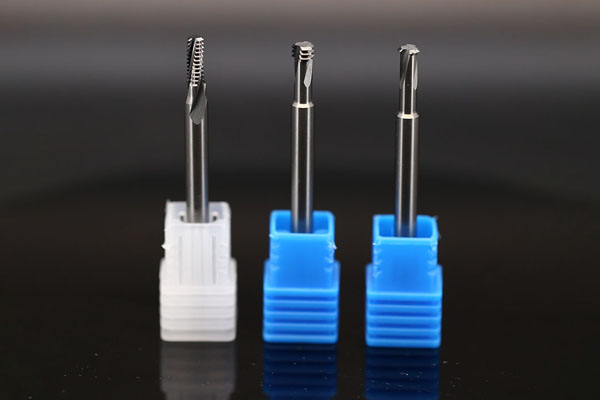
I. Thread Milling Cutters: The Core Tool Reshaping Thread Machining
In the era of rapid CNC machining technology advancement, thread milling cutters have evolved from “niche tools” to “standard equipment” in high-end manufacturing. Unlike traditional taps and dies, thread milling cutters achieve thread machining via 3-axis CNC machines—with the X and Y axes following G03/G02 paths while the Z axis moves synchronously by one pitch. They not only overcome limitations related to thread structure and direction but also deliver a qualitative leap in precision, efficiency, and cost control. Data indicates that the global thread milling cutter market is projected to reach 4.63 billion yuan by 2025, with the Asia-Pacific region accounting for over 45% of the total. Demand is growing particularly rapidly in sectors such as new energy vehicles and aerospace.
As an advanced alternative to traditional tapping processes, thread milling cutters’ core value lies in “flexibility + high precision + cost-effectiveness”—a single tool can machine internal and external threads of multiple directions and varying diameters, boasting a service life 10 to 50 times that of taps. Furthermore, diameter adjustments can be made in real time via tool compensation, completely resolving the industry pain point of workpiece scrapping caused by tap breakage.
II. Core Advantages of Thread Milling Cutters: Why Replacing Taps Is Inevitable
Compared to traditional thread machining tools, thread milling cutters outperform in full-process machining scenarios, especially for high-precision and complex operating conditions:
- Superior Cost-Effectiveness: While the unit price of a single thread milling cutter is higher than that of a tap, the cost per threaded hole is reduced by 30% to 50%. The indexable insert design further cuts consumable costs by more than two-thirds;
- Higher Precision: Crafted from ultra-fine grain cemented carbide (HRA 92+), they achieve machining precision of IT6 to IT7 grade with a surface roughness of Ra ≤ 0.8μm—far exceeding the IT7 to IT8 grade precision of taps;
- Doubled Efficiency: Cutting speeds reach 80 to 200m/min (3 to 5 times faster than high-speed steel taps). The double-edged design shortens machining strokes to half those of traditional tools, and deep hole machining efficiency is boosted by over 300%;
- Wide Application Range: Capable of machining difficult-to-cut materials such as steel, stainless steel, titanium alloy, and superalloys (with hardness up to HRC58-62), they are compatible with blind holes, through holes, and fine/coarse threads. Complete thread machining is achievable without the need for a relief groove;
- Safer Operation: Cutting force is only one-third that of taps, eliminating the risk of chip entanglement. Even if the tool breaks, it can be easily removed—reducing the workpiece scrap rate from 8% to 12% (with taps) to less than 0.5%.
III. Classification & Selection Guide: Precisely Matching Machining Requirements
(1) Main Types and Application Scenarios
| Type | Core Features | Application Scenarios |
| Solid Type | High rigidity, stable cutting performance, TiAlN/AlCrN coating | Small to medium-diameter threads (3-20mm), machining of steel, cast iron, and non-ferrous metals |
| Indexable Insert Type | Cost-effective, double-sided cutting inserts, equilateral triangular inserts with 3 effective cutting edges | Aluminum alloy machining, mass production, general-purpose scenarios for multi-specification threads |
| Welded Type | High customization potential, integrated welding of cutter head and tool body | Deep hole machining, special-shaped workpieces, DIY customization needs |
(2) Core Selection Principles for 2025
- Select Coating Based on Material: TiAlN coating for steel/stainless steel, diamond coating for titanium alloy/superalloys, and uncoated or TiB2 coating for aluminum alloy;
- Choose Tooth Count by Pitch: 4-6 teeth for fine threads (pitch ≤ 1mm) and 3-4 teeth for coarse threads (pitch > 1mm);
- Opt for Cooling Method According to Machining Depth: Internal cooling structures are preferred for deep hole machining (>5 times the diameter), while external cooling suffices for regular machining;
- Match Tool Holder to Precision Needs: HSK/thermal shrink fit tool holders for high-precision applications, and ER/hydraulic tool holders for general scenarios.
IV. Common Machining Issues & Solutions (2025 Updated Version)
Problems such as wear, vibration, and poor surface quality during thread milling are mostly linked to parameter settings, tool selection, or clamping methods. Below are industry-validated, efficient solutions:
| Issue Type | Core Causes | Solutions |
| Plastic Deformation | Overheating in the cutting zone, improper coating grade, insufficient coolant supply | Reduce spindle speed/cutting depth, switch to a high-hardness coating grade, and ensure full coolant coverage of the cutting zone |
| Excessive Wear | High cutting speed, small feed depth, machining of highly wear-resistant materials | Decrease RPM, increase lateral feed rate, and use AlCrN-coated tools to enhance wear resistance |
| Vibration & Abnormal Noise | Improper workpiece/tool clamping, excessive tool overhang, mismatched cutting speed | Use soft jaws for workpiece clamping, shorten tool overhang, adopt anti-vibration tool bars, and optimize cutting speed to 80-120m/min |
| Thread Profile Error | Misalignment of insert center height, incorrect pitch parameters in the program | Adjust the height alignment between the insert and workpiece centerline, verify the pitch parameters in the machining program, and use modular tool holders to improve stability |
| Chip Clogging | Overheating in the cutting zone, improper feed method | Reduce spindle speed/cutting depth, adjust the lateral feed angle to 3°-5°, and select internal cooling tools to enhance chip evacuation |
V. 2025 Thread Milling Cutter Industry Trends: Seizing the Benefits of Technological Advancement
- Material Upgrades: The penetration rate of ultra-fine grain cemented carbide will reach 60%, extending tool life by 30% and significantly reducing Total Cost of Ownership (TCO);
- Structural Innovation: The market share of modular tool holder systems will rise from 30% to 55%, and internal cooling structures will exceed a 70% penetration rate in deep hole machining;
- Coating Iteration: A shift from TiAlN to AlCrN coatings will increase cutting efficiency by 15%, with temperature resistance exceeding 1100℃;
- Intelligent Integration: AI-driven process optimization systems will become widespread, and the market share of smart tools is expected to reach 25% by 2030—enabling real-time adaptive adjustment of machining parameters;
- Application Expansion: Demand for new energy vehicle gearbox machining will grow by 25%, wind power flange machining will form a 1.9-billion-yuan specialized market, and demand for micro-precision thread milling cutters will increase by over 15% annually.
VI. Conclusion: Choosing Thread Milling Cutters Means Embracing an Efficient, Precise Manufacturing Future
With their core advantages of “versatility, high precision, and long service life,” thread milling cutters are driving machining process innovation in the automotive, aerospace, energy equipment, and other industries. Whether for mass production or customized machining, proper tool selection, optimized parameters, and standardized operation can maximize the performance of thread milling cutters—helping enterprises reduce costs and enhance competitiveness.
As intelligent and green manufacturing trends deepen, thread milling cutters will continue to evolve toward “higher precision, greater efficiency, and improved environmental friendliness.” Selecting a thread milling cutter solution tailored to your needs and proactively deploying technological upgrades is key to seizing opportunities in the fiercely competitive market.


