
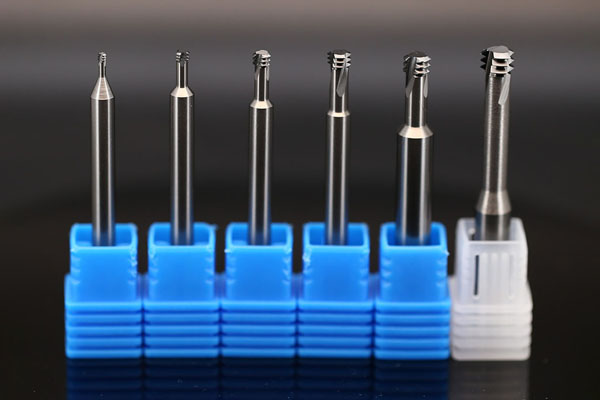
In the field of mechanical processing, threads serve as core structures for connection, transmission, and sealing, and their processing quality directly determines product performance. Traditional thread processing relies on methods such as turning and tapping, which can meet basic needs but gradually show limitations under high-precision and complex working conditions. With the development of numerical control technology, thread milling cutter has become the preferred solution in high-end fields such as aerospace, automotive manufacturing, and medical devices, thanks to its advantages of strong flexibility, high precision, and good durability. This article will comprehensively dissect the key knowledge of thread milling from core principles, process advantages, practical points to common problem solutions, helping practitioners efficiently master this advanced technology.
I. Core Principles of Thread Milling: Precision Control Beyond “Cutting”
Essentially, thread milling is a CNC milling process that processes threads by removing material, where a thread mill is controlled by a CNC program to move along a preset helical path. Unlike traditional tapping, where “the tool’s own shape determines thread specifications,” the core logic of thread milling is “trajectory-controlled forming” — the workpiece remains fixed, and the mill simultaneously performs rotational cutting and helical feeding. The X and Y axes work together to control the thread diameter, while the Z-axis movement accurately ensures the pitch, ultimately forming internal and external threads that meet specifications.
The specific machining path consists of three steps: first, the tool smoothly enters the workpiece along an arc trajectory to avoid edge damage caused by direct impact; then, it cuts at a constant speed along the helical trajectory to ensure full thread profile and uniform precision; finally, it exits along an arc trajectory to eliminate burrs or chipping at the thread end. This processing method can not only adapt to threads of different directions but also achieve variable-diameter thread processing through parameter adjustment, offering far greater flexibility than traditional processes.
II. Core Advantages of Thread Milling: Why Can It Replace Traditional Processes?
Compared with traditional thread processing methods such as turning and tapping, thread milling exhibits significant advantages in multiple dimensions, making it particularly suitable for the stringent requirements of high-end manufacturing scenarios:
1. Exceptional Flexibility, Reducing Tool Costs
A single thread mill can be used for processing internal and external threads of various specifications. Both left-hand and right-hand threads can be achieved by adjusting the CNC program, eliminating the need to equip special taps for different specifications like tapping. Meanwhile, the thread diameter can be fine-tuned through machine parameters to easily meet tolerance requirements, greatly reducing tool inventory pressure.
2. Dual Excellence in Precision and Durability, Enhancing Processing Stability
Thread mills are made of cemented carbide with special coatings (such as TiAlN and CrN), and their service life can be ten to dozens of times that of taps. They are especially suitable for difficult-to-machine materials such as stainless steel, titanium alloys, and high-temperature alloys. CNC linkage control ensures uniform thread profile angle and pitch precision, avoiding thread deformation caused by uneven force during tapping. For special threads without transition threads or undercuts, high-precision processing can be easily achieved.
3. Wide Application Range, Breaking Process Limitations
Thread milling is not limited by workpiece shape; it can stably process non-rotational, asymmetric parts, as well as large boring holes and thin-walled components. In mold manufacturing, it can accurately ensure the hole spacing and thread profile quality of large mold threads; in the aerospace field, it can meet the thread processing needs of high-strength parts such as engine components and landing gear, and even handle tool steel workpieces with a hardness > 45 HRC.
4. High Safety, Reducing Workpiece Loss
During milling, the cutting force is small and distributed, making it less likely to experience tool jamming or chipping that occurs in tapping. Even if the tool is worn, it can be detected and replaced in a timely manner to avoid workpiece scrapping. Additionally, the mill only cuts the thread part specifically without damaging the workpiece’s circumferential surface, making it particularly suitable for processing thin-walled and precision parts.
III. Practical Guide to Thread Milling: Key Points from Tool Selection to Programming
To achieve high-quality thread milling, precise control over three key links — tool selection, parameter setting, and programming optimization — is required, as each step directly affects processing results.
1. Tool Selection: Adaptation to Scenarios is Core
Thread mills can be divided into straight-flute, helical-flute, single-tooth profile, and multi-tooth types by structure, and should be selected based on material characteristics, thread specifications, and processing conditions:
- Straight-flute thread mills: Feature simple chip evacuation paths, suitable for easy-to-machine materials such as aluminum and ABS. They are cost-effective and ideal for small-to-medium batch processing.
- Helical-flute thread mills: With a helix angle of 15-30°, they offer smooth chip evacuation and low cutting vibration, achieving better processing efficiency and surface quality. They are the first choice for medium-hard materials such as stainless steel and alloy steel.
- Single-tooth profile thread mills: Highly flexible, capable of processing internal threads of various specifications. Suitable for small-batch and customized scenarios, they have wide adaptability despite lower efficiency.
- Indexable thread mills: Equipped with replaceable inserts, they are suitable for large-diameter thread processing, reducing tool consumption costs. Widely used in mass production in the automotive and energy industries.
In addition, tool coatings should match the processed material: TiAlN coatings are suitable for high-temperature alloys and stainless steel; CrN coatings reduce built-up edges; DLC coatings are used for low-friction processing of non-ferrous metals.
2. Parameter Setting: Balancing Efficiency and Precision
Cutting parameters directly affect processing precision, tool life, and surface quality, and need to be accurately adjusted based on tool material and workpiece material. Core parameters include cutting speed, feed rate, and coolant supply:
- Cutting speed: For cemented carbide tools processing steel workpieces, the speed is usually 80-120 m/min; for difficult-to-machine materials such as titanium alloys, it should be reduced to 30-50 m/min to avoid accelerated tool wear due to high temperatures.
- Feed rate: Calculated per tooth, generally 0.05-0.15 mm/tooth. Excessively high feed rates may cause steps on the thread profile, while excessively low rates reduce processing efficiency.
- Coolant: Sufficient and precise supply is required, preferably using internal cooling. The flow rate and volume should be moderate to remove cutting heat and flush chips in a timely manner, avoiding built-up edges and cold welding.
3. Programming Optimization: Details Determine Processing Quality
Programming should focus on entry/exit trajectories, thread parameter definition, and anti-vibration design: Arc transitions should be used for entry and exit to avoid right-angle impacts; clarify thread type (e.g., M10x1.5, UNC), pitch, retraction gap, and other parameters to ensure consistency between the program and design requirements; for long-overhang processing, optimize the tool path to reduce the impact of vibration on precision. Meanwhile, it is recommended to reserve a test cutting link to adjust parameters through inspection and avoid batch errors.
IV. Common Problems and Solutions: Accurate Troubleshooting to Improve Stability
During thread milling, problems such as tool wear, chipping, and abnormal thread precision occur frequently. Targeted solutions should be adopted based on their causes. Core problems and solutions are as follows:
1. Accelerated Tool Wear or Built-up Edges
Main causes include improper cutting parameters, poor coating adaptability, and insufficient coolant supply. Solutions: Adjust cutting speed and feed rate according to the tool parameter sheet to avoid excessive spindle speed; replace with coated tools suitable for the material (e.g., TiAlN coatings for stainless steel); increase coolant flow rate and volume, align it accurately with the cutting area, and remove chips promptly.
2. Cutting Edge Chipping
It is mostly caused by tool clamping slippage, insufficient machine rigidity, and excessive cutting impact. Measures to take: Use hydraulic chucks to enhance clamping stability and prevent tool movement; optimize workpiece clamping methods to ensure firm fixation, and add auxiliary supports if necessary to improve rigidity; reduce per-tooth feed rate, adopt radial layered cutting to reduce edge load, and shorten tool overhang length to minimize vibration.
3. Steps on Thread Profile
Main causes are excessive feed rate, improper programming path, or excessive tool wear. Solutions: Appropriately reduce the per-tooth feed rate, adjust the programming trajectory to ensure the tool mills the thread profile curve at the major diameter, avoiding radial movement; shorten tool change intervals and replace worn tools in a timely manner to prevent degradation of thread profile precision.
4. Large Differences in Inspection Results Between Workpieces
It is mostly related to excessive tool overhang, workpiece displacement, and the impact of built-up edges. Actions to take: Shorten the tool overhang as much as possible to improve processing rigidity; check the fixture status and re-clamp the workpiece to avoid displacement during processing; optimize cooling and coating schemes to eliminate the interference of built-up edges on cutting precision.
V. Conclusion: Future Trends and Application Suggestions for Thread Milling
With the increasing requirements for thread precision and efficiency in high-end manufacturing, thread milling will gradually replace traditional tapping and turning to become the mainstream processing method. For practitioners, mastering the core logic of “precision tool selection, rational parameter setting, refined programming, and targeted troubleshooting” is key to improving processing quality and efficiency.
It is recommended to first verify parameter rationality through test cutting in actual production, establish tool wear records, and regularly optimize cooling and lubrication schemes. For difficult-to-machine materials and complex parts, select suitable cemented carbide tools and special coatings to maximize the technical advantages of thread milling. In the future, with the development of 5-axis linkage technology and intelligent tools, thread milling will achieve higher-precision and more efficient automated processing, injecting new vitality into the mechanical manufacturing industry.


