
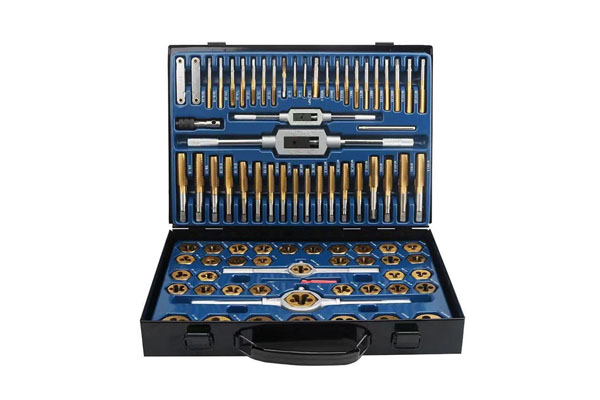
I. What is a Hand Tap and Die Set? Why Every Toolbox Needs One?
A hand tap and die set is a core manual tool combination for cutting or repairing threads, known as the “thread savior” in mechanical maintenance and DIY projects. It mainly includes three types of core tools:
- Taps: Used to cut internal threads (e.g., nuts, threaded holes) in pre-drilled holes. Typically sold in sets of three (taper tap, plug tap, bottoming tap), they respectively handle starting the thread, deepening the cut, and finishing blind holes;
- Dies: Used to cut external threads on round rods or bolts. Some are adjustable to fit different requirements;
- Auxiliary tools: Include tap wrenches, die stocks, and thread pitch gauges, facilitating tool clamping and thread size identification.
Why is it indispensable?
- Maintenance scenarios: Repair rusted/stripped bolts on agricultural machinery and automobiles, clean damaged threaded holes on metal furniture and equipment, avoiding whole-machine scrapping due to small parts failure;
- DIY creation: Cut threads for shelf brackets, lamp hangers, and custom fixtures to make exclusive connectors that meet special installation needs;
- Emergency handling: Quickly cut threads for secure connections during pipeline maintenance (non-pressure-bearing scenarios) and temporary equipment repairs without waiting for professional machinery.
II. Core Knowledge: Thread Specifications and Tap Types – Choose the Right One for the Job
1. Common Thread Systems (Avoid Buying the Wrong Size)
- Metric: e.g., M6×1.0 (6mm diameter, 1.0mm pitch), universally used in household and industrial equipment;
- SAE/Unified: e.g., 1/4″-20 UNC (1/4-inch diameter, 20 threads per inch, coarse thread), commonly found in American-style tools;
- Pipe Thread (NPT): Tapered design, requires Teflon tape for sealing, suitable for non-pressure-bearing air and water pipes (strictly prohibited for gas pipelines).
2. Tap Material and Craftsmanship: Key to Durability
- HSS (High-Speed Steel): Basic model, suitable for common materials like steel, cast iron, and aluminum alloy. It offers high hardness and moderate cost, adopted by most sets (e.g., Hoffmann HSS E material sets);
- Nitriding treatment: A surface strengthening process that improves wear resistance by over 30%, ideal for high-frequency use;
- Spiral flute/Straight flute design: Straight flutes ensure smooth chip evacuation, suitable for through-hole machining; spiral flutes are perfect for blind holes to prevent chip clogging.
III. Step-by-Step Tutorial: Tapping/Threading – Zero Mistakes for Beginners
1. Tapping (Cutting Internal Threads): Three Steps to Avoid Tap Breakage
① Pre-drilling: Select drill bit diameter based on material – for steel: D1=D-P (D=thread major diameter, P=pitch); for cast iron: D1=D-(1.05~1.1)P (e.g., 6.8mm drill bit for M8 steel holes). Chamfer the hole entrance at 45° to facilitate starting;
② Lubrication and cooling: Apply tapping oil (or kerosene as a substitute) to reduce cutting temperature, resulting in smoother threads and doubling tap lifespan (mandatory for soft metals like aluminum and copper);
③ Steady operation: Clamp the tap vertically with a wrench, apply light pressure while rotating clockwise to start. Stop applying pressure after 2-3 turns, and reverse 1/2 turn every 3-4 clockwise turns to clear chips, avoiding tap jamming and breakage;
④ Finishing: After using the taper tap, sequentially use the plug tap and bottoming tap for higher thread precision.
2. Threading (Cutting External Threads): Alignment is Crucial
① Round rod preparation: The diameter should be slightly smaller than the thread major diameter (check specifications). Chamfer the rod end at 45° and remove burrs;
② Fixing and lubrication: Insert the die into the die stock, align it vertically with the round rod, and apply cutting fluid;
③ Rotational machining: Rotate clockwise with light pressure to start. Stop applying pressure after 2-3 turns, and follow the “three advances, two retreats” chip evacuation principle to prevent thread distortion.
IV. Buying Guide: Choose the Right Set for Different Needs
1. Select Specifications by Scenario
- Home DIY: 8-20 piece sets (M3-M12), covering daily maintenance and furniture installation, cost-effective options (e.g., Maktec M3-M12 8-piece set);
- Professional maintenance/Small workshops: 40+ piece sets (M3-M24), including fine-thread specifications (e.g., M12×1.25), suitable for agricultural machinery and CNC equipment. 卡夫威尔 (Kafuwell) 45-piece set and 保拉 (Paola) 40-piece set are highly rated;
- Fine-thread specialized: M8-M20 fine-thread sets, designed for high-precision parts (e.g., aviation brackets, gearboxes) with cold-forged cutting edges for enhanced shear resistance.
2. Pitfall Avoidance Tips
- Prioritize sets with “three taps per size” – single taps are prone to breakage due to excessive force;
- Check tolerance markings (e.g., ISO 2X 6HX) to ensure thread precision;
- Avoid cheap unbranded sets – insufficient cutting edge hardness leads to easy chipping, wasting time and effort.
V. Maintenance and Safety: 5 Tips to Extend Tool Lifespan
1. Clean chips with a wire brush after use, apply anti-rust oil for storage, and avoid humid environments;
2. When machining hard materials (e.g., stainless steel), reduce speed, clear chips frequently, and never apply brute force;
3. When machining hard materials (e.g., stainless steel), reduce speed, clear chips frequently, and never apply brute force;
4. Never blow chips with your mouth; wear safety goggles to avoid eye injury from metal debris;
5. Use appropriate cutting fluid for different materials: machine oil for steel, kerosene for aluminum, and dry cutting for cast iron (smoother with lubrication).


