
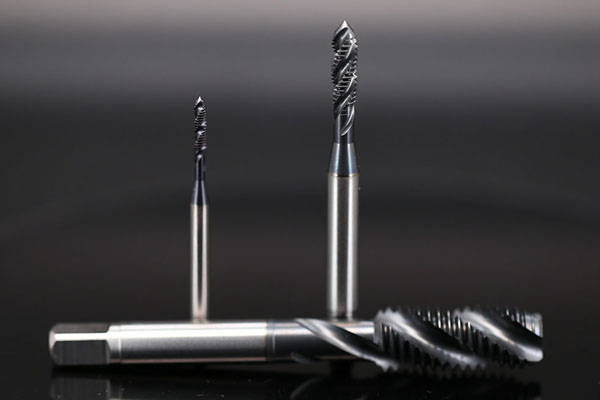
In the field of metal processing, the precision and durability of threads directly determine the assembly quality and service life of mechanical parts. Among numerous thread processing tools, carbide taps have become the “first choice” for scenarios involving high-hardness materials and high-precision requirements due to their outstanding performance. Today, we will conduct an in-depth analysis of the advantages, application scenarios, and selection skills of carbide taps to help you easily cope with the challenges of complex thread processing.
I. What Are Carbide Taps? Why Are They So “High-Strength”?
Carbide taps are thread processing tools made from tungsten carbide (WC) as the main component, mixed with binders such as cobalt (Co), through the powder metallurgy process. Compared with traditional high-speed steel taps, their “high-strength” characteristics are reflected in three aspects:
- 1. Ultra-High Hardness: With a hardness of HRC 89-93, it far exceeds that of high-speed steel (HRC 62-65), enabling easy cutting of high-strength materials such as hardened steel, stainless steel, and high-temperature alloys;
- 2. Excellent Wear Resistance: During high-speed cutting, the cutting edges are not prone to wear, and their service life is 5-10 times that of high-speed steel taps;
- 3. Outstanding Heat Resistance: It can work at a temperature of 800-1000℃, withstand the intense frictional heat generated during high-speed machining, and reduce edge chipping caused by “overheating”.
II. In Which Scenarios Must Carbide Taps Be Used?
Not all machining processes require carbide taps, but in the following scenarios, they can significantly improve efficiency and quality:
- Machining of High-Hardness Materials: Such as hardened steel with hardness ≥ HRC 35, die steel (Cr12, SKD11), and high-strength alloys (titanium alloys, nickel-based alloys). Traditional taps are prone to edge chipping, while carbide taps can achieve stable cutting;
- Mass Production: In the batch processing of auto engine blocks, aerospace components, etc., the long service life of carbide taps can reduce tool change times and lower overall costs;
- High-Precision Thread Requirements: For threaded holes in precision instruments and hydraulic components that require a tolerance grade of 6H/5g6g, the rigidity of carbide taps can ensure accurate thread profiles and reduce deformation;
- Automated Production Lines: On CNC machining centers and automatic tapping machines, the stability of carbide taps can reduce the risk of downtime caused by tool failures.
III. Avoid Mistakes in Selection: How to Choose the Right Carbide Taps?
Selecting the correct type is crucial for exerting the performance of carbide taps. Keep in mind these 3 core indicators:
1. Coating Selection:
- For machining stainless steel and titanium alloys: Choose AlTiN coating (high temperature resistance, anti-adhesion) to reduce “built-up edges”;
- For machining cast iron and cast steel: Choose TiCN coating (high hardness, excellent wear resistance);
- For high-speed dry cutting: Choose DLC coating (low friction coefficient, suitable for non-cooling scenarios).
2. Flute Design:
- For through-hole machining: Choose straight-flute taps (smooth chip evacuation, suitable for high speed);
- For blind-hole machining: Choose spiral-flute taps (chips are evacuated upward to avoid chip clogging at the bottom of the hole);
- For deep-hole machining: Choose spiral-point taps (chips are evacuated forward to reduce cutting resistance).
3. Shank and Precision Grade:
- For automated equipment: Prioritize ground shanks (high precision, stable clamping);
- For ordinary lathes: rolled shanks can be selected (lower cost);
- For precision requirements: 3B/4H is used for precision parts, 6H/7H for general machinery, and 8H for low-precision scenarios.
IV. 4 Practical Tips to Extend Service Life
Although carbide is hard, it has high brittleness. Proper use can avoid edge chipping and breakage:
1. Control Cutting Parameters: The rotational speed should not be too high (80-150 rpm is recommended for stainless steel, 50-100 rpm for hardened steel), and the feed rate should be strictly set according to the thread pitch;
2. Sufficient Cooling and Lubrication: Use extreme-pressure emulsion or special cutting oil, especially when machining stainless steel, to avoid dry cutting;
3. Accurate Pre-Drilling: The pre-drilled hole diameter must meet the standards (e.g., for an M10 tap, the pre-drilled hole diameter is recommended to be 8.5 mm). An excessively large diameter may lead to insufficient thread strength, while an excessively small diameter will increase the cutting load;
4. Regular Wear Inspection: When burrs appear on the thread surface or the precision exceeds the tolerance, replace the tap in a timely manner to avoid the expansion of edge chipping.
V. Conclusion: Carbide Taps Make High-Difficulty Thread Machining “More Effective with Less Effort”
From mold manufacturing to aerospace, from the automotive industry to precision instruments, carbide taps, with their characteristics of “hardness, wear resistance, and high precision”, are reshaping the efficiency and quality standards of high-difficulty thread machining. Selecting the right type and using them correctly can not only help you solve the pain point of “difficult-to-machine materials” but also reduce costs and increase efficiency for the production line by reducing tool changes and improving qualification rates.
If you are looking for a customized carbide tap solution for specific materials or scenarios, please feel free to contact our technical team. We will provide you with full-process support from selection to use!


