
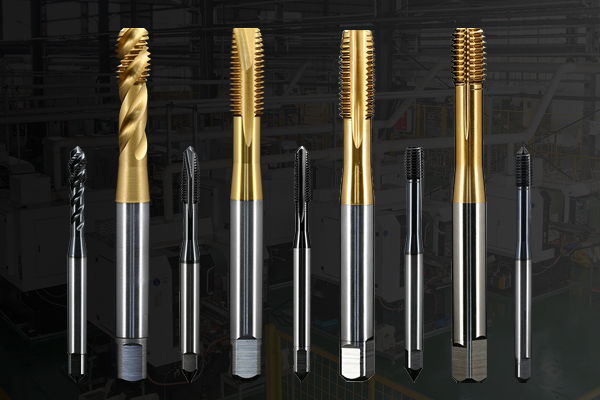
Precision thread manufacturing plays a critical role in industries such as automotive, aerospace, machinery, electronics, and mold manufacturing. The quality of internal threads directly affects assembly accuracy, product reliability, and production efficiency.
Choosing the right tapping tools is essential for achieving high-quality threads, reducing tool breakage, and improving machining performance.
This guide explains different types of tapping tools, their applications, materials, coatings, and how manufacturers can select the best solution for precision thread machining.
1. What Are Tapping Tools?
Tapping tools are cutting tools designed to create internal threads inside drilled holes. They remove material through cutting edges and form accurate thread profiles.
Modern tapping tools are widely used in:
- CNC machining centers
- Automatic production lines
- Automotive component manufacturing
- Aerospace parts processing
- Precision mechanical components
High-performance tapping tools must provide:
- High dimensional accuracy
- Excellent chip control
- Long tool life
- Stable cutting performance
- Consistent thread quality
2. Main Types of Tapping Tools
Different machining conditions require different tap designs.
2.1 Straight Flute Taps
Straight flute taps are traditional and versatile thread cutting tools.
Advantages:
- Simple design
- Good strength
- Suitable for general machining
- Easy chip control in short holes
Applications:
- Cast iron
- Low-carbon steel
- General-purpose machining
2.2 Spiral Flute Taps
Spiral flute taps use a helical groove design to pull chips out of blind holes.
Advantages:
✓ Excellent chip evacuation
✓ Reduced risk of chip clogging
✓ Suitable for deep holes
✓ Improved thread surface quality
Recommended Materials:
- Stainless steel
- Alloy steel
- Aluminum alloys
- Copper materials
2.3 Spiral Point Taps
Spiral point taps, also called gun taps, push chips forward through the hole.
Advantages:
- High cutting efficiency
- Lower cutting resistance
- Suitable for high-speed tapping
- Ideal for through holes
Common Applications:
- Automotive parts
- Steel components
- Mass production
2.4 Forming Taps (Thread Forming Tools)
Unlike cutting taps, forming taps create threads by material displacement.
Advantages:
- No chips produced
- Stronger thread profile
- Longer tool life
- Better thread strength
Suitable for:
- Aluminum
- Copper alloys
- Ductile materials
3. How to Select the Best Tapping Tools?
Selecting the correct tapping tool depends on several machining factors.
3.1 Workpiece Material
Different materials require different tap designs.
| Workpiece Material | Recommended Tapping Tool |
|---|---|
| Carbon Steel | Spiral Point Tap |
| Stainless Steel | Spiral Flute Tap |
| Aluminum | Forming Tap / Aluminum Tap |
| Cast Iron | Straight Flute Tap |
| Hardened Steel | Coated HSS Tap |
3.2 Thread Type and Size
Common thread standards include:
- Metric thread (M)
- Unified thread (UNC/UNF)
- Pipe thread (G, NPT, BSP)
- Fine and coarse threads
The tap must match:
- Thread pitch
- Thread tolerance
- Hole diameter
- Thread depth
3.3 Production Volume
Small Batch Production
Recommended:
- Standard HSS taps
- General-purpose machine taps
Mass Production
Recommended:
- Cobalt HSS taps
- Powder metallurgy taps
- Coated tapping tools
Benefits:
- Longer tool life
- Higher cutting speeds
- Reduced downtime
4. Tapping Tool Materials
HSS (High-Speed Steel)
HSS taps are widely used because of their balance between:
- Toughness
- Cutting ability
- Cost efficiency
Suitable for:
- General machining
- Low to medium production
HSS-Co (Cobalt High-Speed Steel)
Cobalt HSS provides improved:
- Heat resistance
- Wear resistance
- Cutting stability
Recommended for:
- Stainless steel
- Alloy steel
- Difficult materials
Powder Metallurgy HSS
PM-HSS offers:
- Higher hardness
- Better edge retention
- Improved tool life
Ideal for:
- High-speed CNC machining
- Precision manufacturing
5. Importance of Tap Coatings
Coatings improve cutting performance and tool durability.
TiN Coating
Benefits:
- Lower friction
- Better wear resistance
- Extended service life
TiAlN Coating
Benefits:
- High temperature resistance
- Suitable for high-speed machining
DLC Coating
Benefits:
- Excellent performance for aluminum processing
- Reduced material adhesion
6. Common Problems in Thread Manufacturing
Tap Breakage
Main causes:
- Incorrect tap selection
- Poor chip evacuation
- Excessive cutting torque
- Insufficient lubrication
Solutions:
- Choose correct flute design
- Optimize cutting parameters
- Use suitable coolant
Poor Thread Accuracy
Causes:
- Incorrect tap tolerance
- Machine spindle issues
- Tool wear
Solutions:
- Use precision-ground taps
- Check machine alignment
- Replace worn tools
7. Precision Tapping Process Optimization
For high-quality threads, manufacturers should control:
1. Pre-drilled Hole Accuracy
Incorrect hole diameter can cause:
- Oversized threads
- Increased cutting force
- Tap failure
2. Cutting Speed
Too high:
- Increased heat
- Faster wear
Too low:
- Lower efficiency
3. Lubrication
Proper lubrication reduces:
- Friction
- Cutting temperature
- Tool damage
8. Why Choose Chuanhao Tapping Tools?
Sichuan Chuanhao Seiko Mechanical Co., Ltd. specializes in precision thread cutting tools for global machining industries.
Key advantages:
- Over 20 years of thread tool manufacturing experience
- Advanced precision grinding technology
- High-quality HSS and powder metallurgy materials
- Production according to JIS, ISO, and DIN standards
- Strict inspection and quality control systems
Chuanhao tapping tools are widely used for:
- Automotive components
- Precision machinery
- CNC machining
- Stainless steel processing
- Difficult-to-machine materials
Conclusion
The best tapping tools for precision thread manufacturing depend on the combination of:
- Workpiece material
- Thread specification
- Hole type
- Production requirements
- Cutting conditions
Selecting the correct tap design and material can significantly improve thread quality, increase productivity, and reduce machining costs.
For manufacturers seeking reliable threading solutions, high-performance HSS taps, spiral flute taps, spiral point taps, and customized tapping tools provide the foundation for efficient precision manufacturing.


