
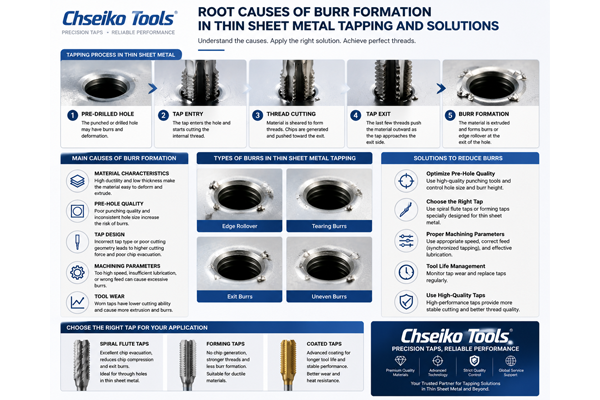
In industries such as automotive components, sheet metal fabrication, electronic equipment, and precision machinery, tapping thin sheet metal parts is a common manufacturing process. However, many manufacturers encounter the same challenge during production:
Why do burrs, edge deformation, and material tearing occur after tapping thin sheet metal components?
Burrs not only affect the appearance of finished parts but can also cause assembly difficulties, reduce thread quality, and impact the reliability of the final product. Therefore, controlling burr formation during thin sheet metal tapping has become a critical concern for manufacturers.
As a professional tap manufacturer, CHSEIKO analyzes the fundamental causes of burr formation from several aspects, including material characteristics, pre-hole quality, tap design, and machining conditions, and provides practical solutions for improving tapping performance.
1. Material Characteristics of Thin Sheet Metal Cause Easy Burr Formation
Compared with conventional machined components, thin sheet metal has unique characteristics:
- Low thickness;
- Limited rigidity;
- High ductility and plastic deformation capability.
During the tapping process, the cutting edges of the tap remove material and form the thread profile. At the same time, the surrounding material is subjected to cutting forces and extrusion pressure, causing plastic flow.
Especially when the tap approaches the exit side of the hole:
- Material support becomes weaker;
- Cutting resistance changes;
- The sheet edge is more likely to stretch and deform.
As a result, defects such as:
- Burrs;
- Edge rollover;
- Residual chips;
- Damaged thread exits;
may occur.
Therefore, the plastic deformation characteristics of thin sheet metal are one of the fundamental reasons for burr formation during tapping.
2. Pre-Hole Quality Directly Affects Tapping Performance
For stamped thin sheet metal parts, the threaded hole is often produced by punching.
During the punching process, the hole edge typically consists of several zones:
- Rollover zone;
- Sheared zone;
- Fracture zone;
- Punching burr zone.
If the punching quality is poor, existing burrs on the hole edge may be pushed and enlarged by the tap during threading, resulting in excessive burr formation.
The pre-hole size is also critical.
If the hole diameter is too small:
It may cause:
- Increased cutting load;
- Higher tapping torque;
- Excessive material deformation;
- Larger burrs.
If the hole diameter is too large:
It may result in:
- Insufficient thread height;
- Reduced thread strength.
Therefore, stable pre-hole dimensions and good hole-edge quality are essential for reducing tapping burrs.
3. Incorrect Tap Design Selection Can Increase Burr Formation
Many manufacturers use standard taps for thin sheet metal applications. However, conventional taps are not always optimized for high-speed thin sheet tapping.
Different tap designs provide different machining characteristics.
3.1 Straight Flute Taps
Straight flute taps have a simple structure and are commonly used for general tapping applications.
However, during continuous thin sheet metal production:
- Chip evacuation may be limited;
- Chips can accumulate in the hole;
- The exit area may experience additional extrusion.
This can result in increased burr formation.
3.2 Spiral Flute Taps
Spiral flute taps provide improved chip evacuation and are widely used for through-hole tapping.
Advantages include:
- Chips are effectively pulled out of the hole;
- Reduced chip compression at the hole exit;
- Improved thread surface quality.
For thin sheet metal and high-efficiency production, properly designed spiral flute taps often provide more stable machining performance.
3.3 Forming Taps (Thread Forming Taps)
For ductile materials such as low-carbon steel and aluminum alloys, thread forming taps can be an effective solution.
Advantages:
- No cutting chips generated;
- Threads are formed through material displacement;
- Higher thread strength.
However, forming taps require accurate control of:
- Material properties;
- Pre-hole diameter;
- Lubrication conditions.
Proper application is essential for achieving stable results.
4. Improper Machining Parameters Increase Burrs
Even with the correct tap selection, inappropriate machining conditions can lead to excessive burr formation.
4.1 Excessive Tapping Speed
High-speed tapping improves productivity, but if the speed exceeds the capability of the material and tap, it may cause:
- Higher cutting temperature;
- Material softening;
- Faster tool wear;
- Increased burr formation.
4.2 Insufficient Lubrication
Although thin sheet tapping involves a small cutting volume, friction between the tap and workpiece remains significant.
Poor lubrication can cause:
- Chip adhesion;
- Increased cutting resistance;
- Thread surface damage;
- Larger exit burrs.
4.3 Excessive Tap Wear
As the number of processed holes increases, the cutting edges of the tap gradually wear.
A worn tap will experience:
- Reduced cutting sharpness;
- Lower cutting efficiency;
- Increased material extrusion.
Typical results include:
- Higher tapping torque;
- Poorer thread quality;
- Gradually increasing burrs.
Therefore, proper tap life management is essential for stable production.
5. How to Reduce Burrs in Thin Sheet Metal Tapping?
To improve tapping quality and minimize burr formation, manufacturers can optimize the process in several ways.
5.1 Improve Pre-Hole Processing Quality
Recommended measures include:
- Maintaining punching tool accuracy;
- Reducing hole-edge burrs;
- Controlling pre-hole dimensions;
- Adding chamfering when necessary.
5.2 Select Taps Designed for Thin Sheet Metal
Professional thin sheet metal taps are optimized in areas such as:
- Cutting edge geometry;
- Rake angle design;
- Flute structure;
- Surface coating technology.
These improvements help reduce cutting resistance and provide more stable tapping performance.
5.3 Select the Correct Tap According to Material
| Workpiece Material | Recommended Tap Type |
|---|---|
| Mild steel sheet metal | High-performance HSS spiral flute taps |
| Stainless steel sheet metal | High-toughness coated taps |
| Aluminum sheet metal | Forming taps or specialized spiral flute taps |
| High-strength steel sheet | Heavy-duty specialized taps |
6. Choose Professional Taps for More Reliable Thin Sheet Metal Tapping
Burr formation in thin sheet metal tapping may appear to be a small issue, but it is actually influenced by multiple factors, including material properties, machine conditions, tooling design, and process control.
A high-quality tap must do more than simply cut threads. It must be optimized for specific materials and applications to ensure stable performance.
Chseiko Tools specializes in the research, development, and manufacturing of high-quality taps. With solutions designed for thin sheet metal tapping, stamped components, and high-efficiency production, Chseiko Tools helps customers improve thread quality, reduce burr problems, and lower overall manufacturing costs.
By selecting the right tap design, optimizing machining parameters, and improving process control, manufacturers can achieve more stable tapping performance and higher-quality threaded holes.


