
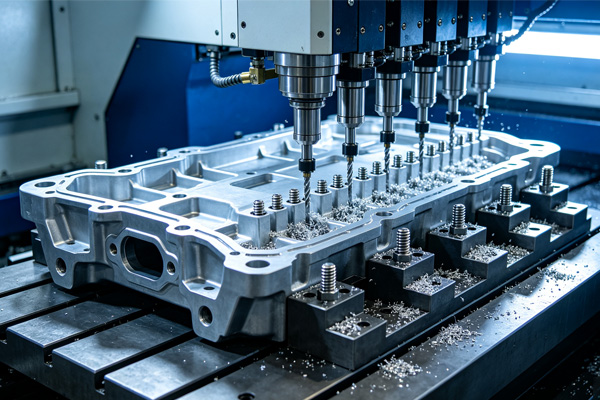
Any machinist has likely faced this frustrating puzzle: two tap tool life of the same model, brand and specification perform very differently — one delivers hundreds of consistent holes, while the other wears or chips after just a few dozen.
At Chuanhao Seiko, a precision threading tool manufacturer, our technical team receives this question regularly. While taps may look identical on paper, their real-world service life depends on a complex mix of material, process and operational factors. Below are the core reasons behind the performance gap.
1. Batch-to-Batch Material & Heat Treatment Variation
Minor fluctuations in high-speed steel alloy content and heat treatment results directly impact hardness, toughness and wear resistance. Under-tempered taps are brittle and prone to chipping; over-tempered ones wear faster.
Chuanhao Seiko narrows this deviation via strict incoming material inspection and automated vacuum heat treatment. All CH series taps go through 100% hardness testing to ensure stable, consistent wear performance across production batches.
2. Workpiece Material Inconsistency
Even the same material grade can vary widely in machinability. Differences in hardness, microstructure, inclusions and work-hardening behavior accelerate abrasive or crater wear on tap edges. Variable workpiece quality is one of the most overlooked causes of uneven tap life.
3. Mismatched Cutting Parameters
Excessive cutting speed generates heat that softens tool edges; too low a speed causes rubbing instead of clean shearing. Incorrect feed rates lead to chip clogging or edge overload. Small differences in actual spindle speed and feed across machines compound into major wear gaps over time.
4. Lubrication Quality & Delivery
Tapping is a high-friction operation where lubrication dictates tool life. Extreme-pressure cutting oil reduces wear far better than diluted soluble fluid; poor coolant delivery to blind holes, or contaminated fluid with metal fines, acts as an abrasive and shortens tap life dramatically.
5. Runout & Alignment Errors
Microns of runout from worn collets, misaligned tool holders or off-center pre-drilled holes create uneven loading on cutting edges. One side of the tap wears rapidly and eventually chips — this is a setup issue, not an inherent tool defect.
6. Coating & Edge Prep Integrity
PVD coatings and precision edge honing protect cutting edges, but mishandling can cause invisible micro-defects that become wear initiation points. Coating thickness and adhesion also vary slightly between batches.
Chuanhao Seiko CH high-performance taps adopt controlled PVD coating and material-specific micro-edge honing, greatly reducing random premature wear from surface quality issues.
7. Poor Re-sharpening Quality
Improper regrinding alters rake angle, relief angle and edge concentricity, or causes burned edges from excess grinding heat. A poorly re-sharpened tap generates higher cutting forces and wears much faster than a properly ground new tool.
Final Takeaway
Uneven tap wear is almost always a system-level problem, not just a tool problem. It stems from variations in material batch, cutting parameters, setup accuracy, lubrication and maintenance. Controlling these variables delivers more consistent performance and lower per-hole costs.
Chuanhao Seiko not only supplies CH threading tools with stable batch quality, but also provides on-site process optimization support to help manufacturers identify hidden wear drivers. For targeted threading solutions, our engineering team is ready to assist.


