
METALEX 2026 ran from 18 to 21 November at BITEC, Bangkok, marking the show’s 40th edition. The organiser’s published figures put it at 55,000 square metres of exhibition space across seven halls, around 3,000 brands from 50 countries, and 100,000 Thai and ASEAN buyers.
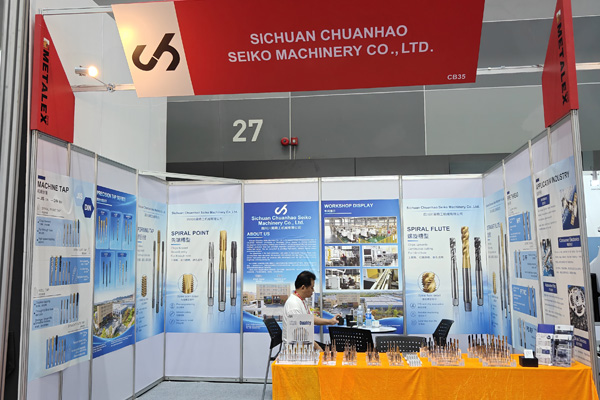
Sichuan Chuanhao Precision Machinery Co., Ltd. brought its full VKS threading range to the show. Over four days, conversations with purchasing staff and process engineers from automotive parts, electronics hardware, valves and fittings, tooling and general machinery kept circling back to one question: how many good holes will this tap produce, on my machine, in my material.
1. Why Bangkok: ASEAN’s tapping jobs are getting harder
Thailand remains one of ASEAN’s key automotive and electronics manufacturing bases. As EV programmes, electronics manufacturing services and precision hardware lines expand, so does the volume of aluminium die-cast parts, sheet-metal structures and stainless steel piping. The material mix gets wider and cycle times get shorter, which leaves less margin for error in what looks like a minor operation. Aluminium smears and packs the flutes; stainless steel work-hardens and chips the edge; on an automated line, one broken tap can stop the cell.
That is also why METALEX is worth a trip every November. For its 40th edition the show added ROBO WOW, a humanoid robotics showcase, and ran alongside Subcon Thailand and Automation Expo. Automation is reshaping ASEAN’s shop floors, and the more automated a line becomes, the less tolerance there is for inconsistency in tooling.
2. On the stand: one product line, from standard to custom
The VKS display was organised along three axes, so that a visitor could match a tap to a job at a glance.
- By flute geometry. Spiral point taps for through holes, with chips pushed forward; spiral flute taps for blind holes, with chips lifted up the helix; straight flute taps for mixed production where through and shallow blind holes both appear; forming taps that cold-form the thread without cutting, suited to aluminium, copper and low-carbon steel where a clean thread matters.
- By standard. JIS, DIN and ISO as the main lines, covering metric, imperial, UN and pipe thread sizes, with custom dimensions, special pitches and extended shanks made to drawing.
- By substrate. Premium HSS, cobalt HSS, powder metallurgy HSS and solid carbide, paired with TiN, TiCN, TiAlN and AlCrN coatings to cover the range from aluminium alloys to hardened steels.
- Special-purpose and pipe threads. High-helix taps for aluminium, stainless-specific taps, solid carbide taps for hardened material, and NPT, GPF and PT/RC series for hydraulic, pneumatic and valve fitting work.
3. Three questions we heard most
Aluminium: where does the smearing come from? In die-cast and extruded aluminium the problem usually sits in chip evacuation and friction rather than in operator technique. The approach we recommended: get the chip out first, using a high helix angle together with edge passivation and mirror polishing, or move to forming, which produces no chip at all.
Stainless and hardened steel: why does life vary several times over at the same specification? The gap usually sits in substrate, heat treatment and coating match. For 304 and 316, where work-hardening is severe, cobalt HSS with TiAlN or AlCrN is the steadier choice; hardened and mould steels go to the solid carbide spiral point, spiral flute and straight flute lines.
Automation: how do you bring the breakage rate down? Robotic loading and multi-spindle tapping change the requirement from “it works” to “every piece behaves the same”. Batch consistency, edge consistency and full dimensional inspection became the questions buyers asked after price.
4. Tapping is never just a tap
Hole size, speed and feed, coolant strategy, fixture rigidity and coating selection: any one of them out of step will retire a good tap early. What our team did at the stand was to work backwards, establishing the workpiece material, the hole type, the machine and the cycle time, then specifying flute geometry, tolerance class and coating.
It is the same point we keep making in our technical articles: most tapping problems in hardened steel are a matching problem, not an operating problem. That holds in ASEAN as well. Standard products are the starting point; the match to actual conditions is what decides downtime and yield.
5. About Sichuan Chuanhao Precision Machinery
Located in the Suining Economic and Technological Development Zone in Sichuan, the company is the Southwest China threading tool production base established by Chuanhao Precision Machinery (Shanghai) Co., Ltd. It focuses on the development, manufacturing and wholesale of machine taps, sold under the VKS brand to domestic factories and to export markets.
The plant runs more than 200 intelligent machining units across over 20,000 square metres, holds more than 30 patents and software copyrights, is certified to ISO 9001, and is recognised as a High-Tech Enterprise and a Technology-Based SME. Production covers the full chain, from raw material preparation and flute grinding to coating and final inspection.
6. Closing
The halls in Bangkok have closed and the stands are down, but the questions remain. Material mixes across ASEAN are getting wider and cycle times shorter; thread cutting is moving from a consumable line item to a variable that affects yield and uptime.
For Chuanhao Seiko, METALEX 2026 was less a showcase than a test: Chinese manufacturing capability measured against real conditions on ASEAN shop floors. The next stop will again include samples and a parameter sheet.


